An alternative approach than using the find public member function is to build a routine that captures the first index of the first substring character without the find method. In this alternative approach a pointer is created to the parent string and then a pointer to a c-string array of characters is created with the original character used in the parent string. If the substring is completely matched then the first character position is returned.

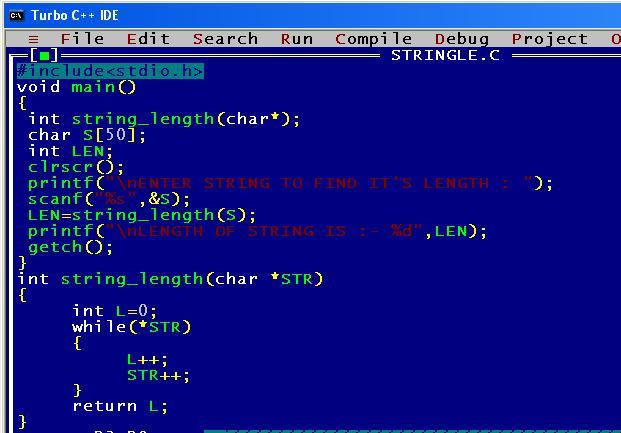
In this article, we explained several approaches that are used to get the length of different strings in C++. The C++ strings are arrangements of letters or characters saved in adjacent memory addresses. To obtain the length of the C-style strings, we utilize the strlen() method.

In the string, the constructor sets it to a C-style string ending in "\ 0". In the last method, we use a built-in function str.length(). This method is quite easy to implement because we just call the built-in function and obtain the length.

Check out other Linux Hint articles for more tips and information. Every object has a storage duration, which correlates with its lifetime. Objects with static storage duration live from the point of their initialization until the end of the program. Such objects appear as variables at namespace scope ("global variables"), as static data members of classes, or as function-local variables that are declared with the staticspecifier.

All objects with static storage duration are destroyed at program exit . We cannot modify string literals; to do so is either a syntax error or a runtime error. String literals are loaded into read-only program memory at program startup. We can, however, modify the contents of an array of characters. Strings are one of the most interesting parts of the software development. We usually get input from a user as a string then process it to obtain the results.

Dealing with the strings are a bit tricky so we need to know ways to handle frequent problems. Splitting a string can be perceived as dividing it into parts which we are more interested. Suppose that you need to extract words from a sentence where these words are separated by comma . You need an efficient and simple way to get the part you are interested in — the words — .

Same thing applies for other types, you may need to extract numbers, special characters and even whitespaces. In this article, we will inspect the methods we can use when we need to split a string. In C, when we use the term string, we're referring to a variable length array of characters.

It has a starting point and ends with a string-termination character. While C++ inherits this data structure from C, it also includes strings as a higher-level abstraction in the standard library. For instance, they can be declared at namespace scope, inside functions, or as static class members, but not as ordinary class members. Therefore, we only allow objects with static storage duration if they are trivially destructible. Fundamental types are trivially destructible, as are arrays of trivially destructible types. Note that variables marked with constexpr are trivially destructible.

Global and static variables that use dynamic initialization or have non-trivial destructors create complexity that can easily lead to hard-to-find bugs. Dynamic initialization is not ordered across translation units, and neither is destruction . When one initialization refers to another variable with static storage duration, it is possible that this causes an object to be accessed before its lifetime has begun . Moreover, when a program starts threads that are not joined at exit, those threads may attempt to access objects after their lifetime has ended if their destructor has already run. Note that all of the bytearray methods in this section do not operate in place, and instead produce new objects. Objects withstatic storage duration are forbidden unless they aretrivially destructible.

Informally this means that the destructor does not do anything, even taking member and base destructors into account. More formally it means that the type has no user-defined or virtual destructor and that all bases and non-static members are trivially destructible. Static function-local variables may use dynamic initialization. Use of dynamic initialization for static class member variables or variables at namespace scope is discouraged, but allowed in limited circumstances; see below for details. By setting the value of JUCE_STRING_UTF_TYPE to 8, 16, or 32, you can change the internal storage format of the String class. UTF-8 uses the least space , but call operator[] involves iterating the string to find the required index.

UTF-32 provides instant random access to its characters, but uses 4 bytes per character to store them. UTF-16 uses more space than UTF-8 and is also slow to index, but is the native wchar_t format used in Windows. All those coders who are working on the C++ based application and are stuck on how to find last character of string in c++ can get a collection of related answers to their query. Programmers need to enter their query on how to find last character of string in c++ related to C++ code and they'll get their ambiguities clear immediately. On our webpage, there are tutorials about how to find last character of string in c++ for the programmers working on C++ code while coding their module.

Coders are also allowed to rectify already present answers of how to find last character of string in c++ while working on the C++ language code. Developers can add up suggestions if they deem fit any other answer relating to "how to find last character of string in c++". ¶Return a bytes or bytearray object which is the concatenation of the binary data sequences in iterable. A TypeError will be raised if there are any values in iterable that are not bytes-like objects, including str objects.
The separator between elements is the contents of the bytes or bytearray object providing this method. The C++ solutions already posted are pretty reasonable. There is no reverse strpbrk as there is for strchr, at least that I know of. In other words, a C string is nothing more than a char array. Just as C doesn't track the size of arrays, it doesn't track the size of strings.

Instead, the end of the string is marked with a null character, represented in the language as '\0'. So, if we give the cout the address of a character, it prints everything from that character to the first null character that follows it. So to create the .substr() for the conversion we simply find the first char that is not a space and extract the maximum number of chars possible for the data type. The start of the next extraction is simply computed by adding the position of the first digit found to that of the returned position from stoul() .

If this is less than the end position (endstr - last after trailing spaces have been discarded) then all's well for the next extraction – otherwise the conversion is complete. The second point is that there is no way to tell at which point in the given string the conversion terminates. Conversion of " 123qwe" and "123" both return a value of 123. Hence in the above code, the converted chars have to be skipped over again (they have already been read once by atol()) before atol() is called again for the next conversion.
The first one simply skips to the first non-space char because although atol() would skip past these spaces, the code would still need to skip these so that the digits can be skipped. By putting the first loop before atol(), any initial spaces are only skipped over once for performance. I can well remember writing such a conversion routine as one of my first assembler programs back in the 1970's. Also beware that depending on the encoding format that the string is using internally, this method may execute in either O or O time, so be careful when using it in your algorithms. Developers are finding an appropriate answer about how to find last character of string in c++ related to the C++ coding language. By visiting this online portal developers get answers concerning C++ codes question like how to find last character of string in c++.

Enter your desired code related query in the search bar and get every piece of information about C++ code related question on how to find last character of string in c++. Compared to the overhead of setting up the runtime context, the overhead of a single class dictionary lookup is negligible. Format¶A string containing the format for each element in the view. A memoryview can be created from exporters with arbitrary format strings, but some methods (e.g. tolist()) are restricted to native single element formats. For non-contiguous arrays the result is equal to the flattened list representation with all elements converted to bytes.

Tobytes()supports all format strings, including those that are not instruct module syntax. Both bytes and bytearray objects support the commonsequence operations. They interoperate not just with operands of the same type, but with any bytes-like object. Due to this flexibility, they can be freely mixed in operations without causing errors.

However, the return type of the result may depend on the order of operands. The core built-in types for manipulating binary data are bytes andbytearray. They are supported by memoryview which uses the buffer protocol to access the memory of other binary objects without needing to make a copy. This is a successive assortment of letters or an array of characters. The assertion and delineation of a string containing a collection of characters are similar to the assertion and delineation of an arrangement of other data types. In C ++, the length of a string signifies the number of bytes that are utilized to encrypt the specified string.

This is because bytes are generally mapped to C ++ characters. This returns the character at a specified position at the indexNo specified by the user. The method throws an out_of_range exception when an invalid index number is passed, like an index less than zero or an index greater than or equal to string.size().

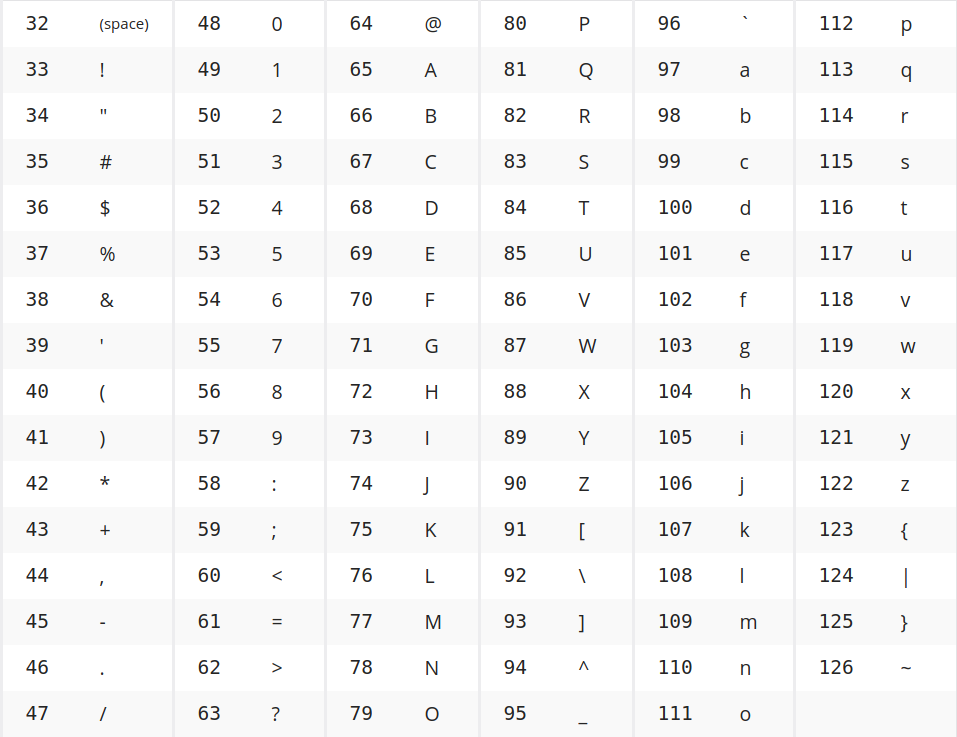
A C-style string is simply an array of characters that uses a null terminator. A null terminator is a special character ('\0', ascii code 0) used to indicate the end of the string. More generically, A C-style string is called a null-terminated string. The c_str() returns the contents of the string as a C-string. Actually, it returns a pointer to const array in order to prevent the array from being directly manipulated.

That's why we need const qualifier in the example code. Note that C++ strings do not provide a special meaning for the character '\0', which is used as special character in an ordinary C-string to mark the end of the string. The character '\0' is part of a string just like every other character.

In both cases, each initialize a variable to the string "hello". The first declaration creates a six-element array str containing the characters 'h', 'e', 'l', 'l', 'o' and '\0'. The second declaration creates pointer variable pStr that points to the letter h in the string "hello", which also ends in '\0', in memory. For functions that have several configuration options, consider defining a single class or struct to hold all the options , and pass an instance of that. Options are referenced by name at the call site, which clarifies their meaning.

It also reduces function argument count, which makes function calls easier to read and write. As an added benefit, you don't have to change call sites when you add another option. Objects of copyable and movable types can be passed and returned by value, which makes APIs simpler, safer, and more general.
Unlike when passing objects by pointer or reference, there's no risk of confusion over ownership, lifetime, mutability, and similar issues, and no need to specify them in the contract. It also prevents non-local interactions between the client and the implementation, which makes them easier to understand, maintain, and optimize by the compiler. Further, such objects can be used with generic APIs that require pass-by-value, such as most containers, and they allow for additional flexibility in e.g., type composition. If appropriate for your code , terminating the program may be an appropriate error handling response. Otherwise, consider a factory function or Init() method as described inTotW #42. Avoid Init() methods on objects with no other states that affect which public methods may be called (semi-constructed objects of this form are particularly hard to work with correctly).

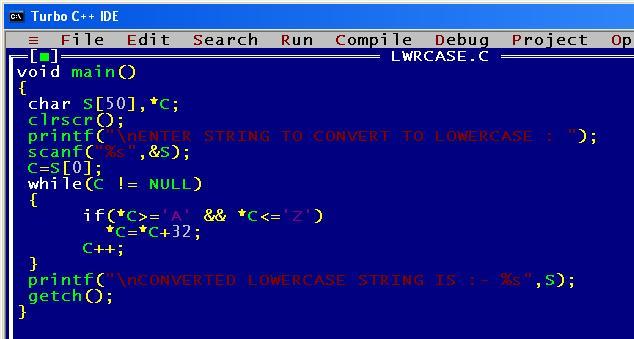
This looks at some binary data and tries to guess whether it's Unicode or 8-bit characters, then returns a string that represents it correctly. Since we can only convert characters to upper case, and not strings, we have to handle the string one character at a time. To do that, we use the square brackets, as if we were dealing with an array of characters, or a vector of characters.
A memoryview has the notion of an element, which is the atomic memory unit handled by the originating object. For many simple types such as bytes and bytearray, an element is a single byte, but other types such as array.array may have bigger elements. The following methods on bytes and bytearray objects assume the use of ASCII compatible binary formats and should not be applied to arbitrary binary data.
Bytes objects are immutable sequences of single bytes. The object is required to support the iterator protocol described below. If a container supports different types of iteration, additional methods can be provided to specifically request iterators for those iteration types. The latter function is implicitly used when an object is written by the print() function.

A good point that was brought up to me on this tutorial is that if you search for the word "Hello" in the parentstring then the index of 0 is returned. If 0 is returned then the if statement would fail and the previous method I had described above would only be usable for substrings that are found at an index greater than 1. An alternative approach would be to check for the second character of the substring starting at index 1. In the example below the zeroIndexChar would return as 1 and the substring would be found at 0.

If you have ever wondered how to find a substring inside another string in C++ then hopefully this tutorial will help walk you through how to do that. This tutorial takes advantage of C++ Standard Library String functions that are most commonly used by C++ developers for their day to day development operations. If they're always at the end, then just start at the end of the string and look for a digit, when you get to the first non digit number, then you have it.


No comments:
Post a Comment
Note: Only a member of this blog may post a comment.